
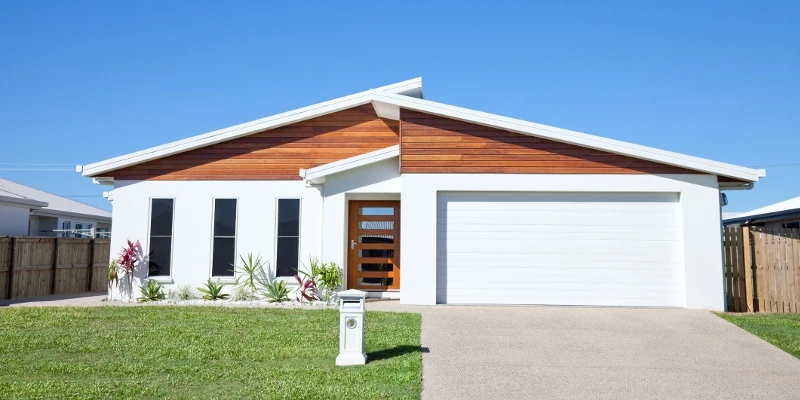
If you own a home anywhere from Parkland down to Hollywood, or from Boca Raton up to Jupiter, the short answer is yes: when you replace your garage door, the new one has to be rated for hurricane winds, and in Broward County it also has to be rated to stop flying debris. But "hurricane-rated" gets thrown around loosely, and the rules are not the same on both sides of the Broward–Palm Beach line. Here is what the code actually requires, how to tell what you have now, and what it means for your home the next time a storm spins up in the Atlantic.
Why the garage door matters more than any other opening
Your garage door is the largest, thinnest, most flexible opening on your house. During a hurricane, wind does not just push on it; it pushes and pulls in rapid cycles as gusts hit and release. A door that is not built for that will bow inward, pop out of its tracks, or get punched through by debris.
Once the door fails, the wind is inside your garage. The pressure inside the house jumps, and that pressure now pushes up on the roof deck and out on the walls at the same moment the wind outside is pulling up on the roof. That is the "cascade" that turns a damaged garage door into a lost roof and a flooded house.
The Insurance Institute for Business & Home Safety (IBHS) studied this after real storms and found that roughly 90% of homes whose garage door survived had no structural damage to the roof. The door is not just a door. It is the first domino.
The line that runs between Broward and Palm Beach
Florida's building code draws a special zone called the High-Velocity Hurricane Zone (HVHZ). It covers exactly two counties: Miami-Dade and Broward. Palm Beach County is not in it.
That one fact changes what your garage door has to be.
If you live in Broward County (Coral Springs, Parkland, Coconut Creek, Pompano Beach, Deerfield Beach, Fort Lauderdale, and the rest)
You are in the HVHZ, and every replacement garage door has to pass the strictest testing in the country. The door assembly, meaning the panels, tracks, hinges, brackets, and fasteners as one system, has to pass three tests:
- TAS 201 – large missile impact. A 9-pound 2×4 is fired at the door at roughly 50 feet per second. The door cannot be penetrated.
- TAS 202 – uniform static pressure. The door is loaded with steady positive and negative pressure to prove it holds its rated design pressure.
- TAS 203 – cyclic pressure. After the impact test, the same door endures thousands of alternating pressure cycles that mimic hours of hurricane gusting. It has to keep its integrity the whole way through.
In plain English: in Broward, a garage door has to take a hit from flying debris and then survive the rest of the storm. A door that is only "wind-load rated" (pressure tested but not impact tested) does not meet code here, even if it has no windows. There is no such thing as a standard, non-impact garage door installed legally in Broward County anymore.
The approval paperwork is either a Miami-Dade Notice of Acceptance (NOA) or a Florida Product Approval (an "FL number") that specifically lists HVHZ compliance. Both are accepted in Broward.
If you live in Palm Beach County (Boca Raton, Delray Beach, Boynton Beach, Lake Worth, West Palm Beach, Wellington, Jupiter, and the rest)
You are outside the HVHZ but inside what the code calls the Wind-Borne Debris Region, which covers essentially the whole county. The design wind speed your door has to be engineered for runs from about 160 mph in the western communities like Wellington, Royal Palm Beach, and Loxahatchee up to about 170 mph along the coast in Palm Beach, Manalapan, Gulf Stream, and Highland Beach.
Your replacement door must carry a Florida Product Approval showing it meets the design pressure for your specific address, mean roof height, and exposure (a home within a few hundred feet of open water is rated harder than one in a tree-lined neighborhood). If the door has any glass, that glass has to be impact-rated, no exceptions. And while the letter of the code allows a solid, pressure-rated door in some Palm Beach situations, most municipalities, inspectors, and insurers in the county now expect a full impact-rated door, and that is what we recommend. The cost difference is modest and the insurance and resale implications are not.
How to find out what you have right now
Open the door, stand inside the garage, and look at the inside face of the panels, usually near the bottom section or along one edge. Every code-compliant door installed in Florida in the last two decades has a permanent manufacturer label. It will show:
- The manufacturer and model
- The approval number (an FL number or a Miami-Dade NOA number)
- The design pressure rating, written as positive and negative PSF (pounds per square foot), for example +38.0 / –42.0
If there is no label, or it has been painted over, or the number on it has expired (approvals are renewed on a cycle and a lapsed number is not valid for a new permit), then for code and insurance purposes your door is unrated. IBHS found that away from the coast, 80–90% of garage doors either have no label or an incomplete one. Closer to the ocean the numbers are better, but we still see plenty of older doors in Coral Springs and Boca that would not pass today.
A few red flags we run into on service calls:
- Aftermarket windows. Someone added decorative glass to a rated door. The rating is now void because the assembly was changed.
- Mismatched hardware. A rated door hung on standard tracks, light-gauge brackets, or the wrong fasteners. The panels may be fine; the system is not.
- The wrong door for the address. A door rated for Exposure B installed in an Exposure C or D location. It has a label, but not the right one.
What about hurricane bracing kits?
You have probably seen the vertical steel posts that anchor into the floor and header. Bracing kits were a legitimate way to strengthen older doors 20 years ago, and in a pinch they still add real stiffness.
But they are a temporary measure, not a replacement for a rated door, and here is the important part for our area: a bracing kit does not bring an old door up to code in Broward County, and it does not satisfy the wind-mitigation requirements insurers use. The kit has to be installed before winds pick up (typically before sustained winds hit 35 mph), the floor anchors have to go into solid structural slab rather than a post-tension slab or a topping layer, and the door still has no impact rating. If your door predates the current standards, the kit buys you time. It does not buy you compliance.
If you are wondering whether a rated door will help your premium, we cover that in our wind-mitigation guide.
What a rated door does not do
It is worth being honest about the limits. A hurricane-rated garage door is designed to keep wind and debris out so the house stays pressurized correctly. It is not a flood barrier. Storm surge and street flooding come under the door, and in low-lying parts of eastern Broward and coastal Palm Beach, that is often the bigger risk than wind. If flooding is your concern, ask us about threshold seals and about pairing the door with a proper flood plan rather than expecting the door to hold water back.
Buying a rated door: what to look for
- Approval that matches your county. In Broward, HVHZ-listed NOA or FL approval. In Palm Beach, an FL approval rated at or above the design pressure for your address.
- Impact rating on the whole door, not just on the glass.
- Factory-engineered reinforcement. Modern rated doors have internal struts and heavier gauge steel built in. You should not need to add anything.
- Matching tracks, springs, and opener. A rated door is heavier. The spring system and opener have to be sized for it, and the tracks and jamb brackets have to be the ones tested with the door.
- A label you can read, and paperwork you can keep in your file for the next wind-mitigation inspection.
The timing problem nobody mentions in May
Hurricane-rated doors are built to order. Lead times run several weeks in a normal year, and permits add time on top of that. Once a storm has a name, everyone in South Florida calls at once and lead times stretch. If you know your door is old, unrated, or damaged, the right time to replace it is before June 1, not the week a cone appears on the news.
Frequently asked questions
My house was built in the 1990s. Do I have to replace my garage door? No law forces you to replace a working door. But the moment you replace it, the new one must meet current code, and an unrated old door will cost you on your insurance and at resale. Many of our customers replace proactively for exactly those reasons.
I live in Coral Springs. Is a wind-load rated door good enough? No. Coral Springs is in Broward County, which is HVHZ. The door must be large-missile impact rated (TAS 201/202/203), not just pressure rated.
I live in Boca Raton. Do I need an impact-rated door? Boca is in Palm Beach County, outside the HVHZ. The code requires a Florida-approved door rated for your address's design pressure, and any glass must be impact-rated. We recommend a fully impact-rated door in Boca and everywhere in Palm Beach County; it is what inspectors and insurers expect, and the cost difference is small.
Can I just add windows to my rated door later? Not without voiding the rating. Order the door with impact-rated windows from the factory if you want glass.
What does "design pressure" on the label mean? It is the amount of wind pressure, in pounds per square foot, that the door was tested to resist pushing in (positive) and pulling out (negative). The number your door needs depends on your address, the size of the door, roof height, and how exposed the property is.
Does a rated door need a special opener? It needs an opener rated for the door's weight, and in most of our installs we recommend a belt-drive opener with battery backup so you can get the car out during the outage that follows every storm.
How much more does a hurricane-rated door cost? It depends on the size, style, and insulation you choose, but for a standard two-car door the difference between a basic rated door and a premium impact door is usually far less than a single insurance deductible. We will price it for your exact address and design pressure.
Ultra Garage Doors has been installing and servicing hurricane-rated garage doors across Broward and Palm Beach counties since 2007. We pull the permit, match the approval to your address, and handle the inspection. Call us at 561-494-4070 for a free quote, or if you are not sure what door you have, we will come look at the label with you.